
Did you know that 27% of Volusia County listings currently feature price cuts, yet many buyers still overpay because they lack a data-driven strategy? Entering the 2026 market in Daytona Beach or
Dated: September 16 2026
Views: 0

Are you unknowingly overpaying your property taxes while your neighbors enjoy massive savings? In the fast-moving Florida real estate market, missing a single detail in your filing can cost you thousands. Mastering the Florida homestead exemption requirements is the most critical step any homeowner in Daytona Beach or Port Orange can take this year. It's not just a one-time discount. It's a strategic pillar of residency that secures a long-term financial shield for your home.
We know that legal jargon and strict deadlines feel overwhelming. You shouldn't have to be a tax attorney to protect your property. This 2026 guide cuts through the noise to provide an expert-led breakdown of how to qualify and file with precision. You'll learn how the base $25,000 exemption works, how Amendment 5 adjusts your savings for inflation, and why the March 1 deadline is non-negotiable. We're stripping away the complexity so you can claim your $51,411 exemption with total confidence. It's time to lock in your savings and secure your financial future.
The Florida Homestead Exemption is a powerful constitutional benefit reserved for permanent residents of the Sunshine State. It's not a suggestion; it's a legal right that serves as your primary defense against escalating property taxes. For homeowners in Daytona Beach, Port Orange, and Ormond Beach, meeting the Florida homestead exemption requirements is the single most important financial move you can make after closing. Securing this exemption isn't just about the current year. It's about building a foundation for your financial future in Florida. This exemption provides a dual-layered advantage by reducing your home's taxable value and capping future assessment increases.
This benefit is exclusive to your primary home. You cannot apply it to vacation rentals, second homes, or investment properties. Florida law requires that you own the property and occupy it as your permanent residence to qualify. Our team utilizes AI-powered search tools to help you identify properties that are eligible for these massive savings, ensuring your investment is protected from day one. If you want to maximize the value of your Florida home, you must treat this exemption as a non-negotiable priority.
The immediate benefit is a significant reduction in your property's assessed value. For most homeowners, this means up to $50,000 is stripped away from the taxable total before the millage rate is even applied. While the initial savings are impressive, the long-term protection is where the real wealth is built. The "Save Our Homes" provision ensures your assessed value cannot increase by more than 3% annually, or the percent change in the Consumer Price Index, whichever is lower. This cap effectively decouples your tax bill from the volatile swings of the market. Even if your home's market value doubles in a few years, your tax burden remains stable and manageable. This is why we prioritize Florida homestead exemption requirements for every client we serve in the Volusia County area.
Florida law is very specific about which properties qualify. To claim this exemption, the property must be your permanent residence. This means it's the place you intend to return to and live in indefinitely. You cannot claim a homestead exemption in two different states or on two different properties at the same time. Doing so constitutes homestead fraud, which carries heavy penalties and back-tax requirements. Accuracy is paramount. If you own a condo in New Smyrna Beach but your primary life is in another state, you won't qualify. This benefit is strictly for those who call Florida home. We act as your proactive advocate, ensuring you understand exactly how to prove residency so your application is approved without delay.
Qualifying for tax relief in the Sunshine State isn't a matter of opinion. It's a matter of law. To secure your 2026 savings, you must satisfy three distinct pillars simultaneously. If you fail to meet even one, your application will be denied. These Florida homestead exemption requirements ensure that only dedicated residents benefit from the state's tax protections. You must establish ownership, prove permanent residency, and verify your legal status to unlock the full suite of benefits. All three conditions must be active as of January 1st to qualify for that tax year.
The Florida Department of Revenue maintains strict oversight of these criteria to prevent abuse. First, you must hold legal or beneficial title to the property. Second, the home must be your permanent residence. Finally, you must be a U.S. citizen or hold a permanent resident card. If you are currently searching for a home, you can use our AI-powered property search to find residences in Volusia County that fit your financial goals and residency plans.
Your deed is the primary proof of ownership. It must be officially recorded with the Volusia County Clerk of Court to be valid for tax purposes. If you are moving into a new home in Daytona Beach or Ormond Beach, ensure your name is on the title by December 31st of the year prior to your filing. Beneficial title also qualifies. This applies if your property is held in a trust, provided you have a life estate or a specific interest that grants you the legal right to occupy the home. Accuracy at the closing table prevents headaches at the tax office.
Residency is more than just living in a house. It's about intent. You must demonstrate that Florida is your one and only permanent home. The state tracks this through several data points. Be prepared to show your Florida driver's license, vehicle registration, and voter registration. Utility bills and bank statements also serve as vital evidence. Crucially, you must relinquish any residency-based tax credits in other states. You cannot claim a "Star" exemption in New York or similar benefits elsewhere while filing for Florida's homestead. The state actively audits these records. Meeting all Florida homestead exemption requirements means fully committing to your life in Volusia County.
Establishing your residency and meeting the Florida homestead exemption requirements is just the first step. The real wealth preservation begins with the "Save Our Homes" (SOH) amendment. This constitutional benefit creates a structural cap on your property taxes that compounds every year you own your home. It's not merely a discount. It's a powerful financial mechanism that rewards long-term Florida residents. By understanding how to leverage SOH and portability, you can move across the state without losing the tax advantages you've spent years building.
In a high-demand market like Daytona Beach or Port Orange, property values often surge. Without protection, your tax bill would skyrocket alongside your home's value. The SOH provision prevents this. Once you qualify, your property's assessed value cannot increase by more than 3% per year, or the rate of inflation, whichever is lower. Over time, a significant gap develops between the market value of your home and its taxed value. This gap represents thousands of dollars in annual savings that stay in your pocket rather than going to the county. The Save Our Homes cap acts as a definitive shield against the Florida real estate boom.
It's vital to recognize that this cap is not permanent for the property itself. When a home is sold, the assessment resets to the full market value for the new owner. This is why we advise our clients to verify the current tax status of any property they consider. You can't assume you'll pay what the previous owner paid. However, if you're already a Florida resident, you have a secret weapon called portability.
Portability allows you to transfer your accumulated SOH tax savings to a new primary residence anywhere in Florida. This makes upgrading to a luxury home in Ponce Inlet or Ormond Beach far more attainable. You can transfer up to $500,000 of your assessment difference to your new property. If you are "upsizing" to a more expensive home, you can typically port the entire difference. If you are "downsizing," the benefit is calculated as a pro-rated percentage. This flexibility ensures that your loyalty to the state is rewarded with continued tax relief.
Timing is everything. You have three tax years from January 1st of the year you sold or abandoned your previous homestead to claim this benefit. Missing this window means starting from zero. Following the Florida Department of Revenue guidelines is essential to ensure your application is processed correctly. Portability is a complex strategic tool that requires precision. We act as your strategic partner, helping you calculate these savings during the search process so you can buy with total clarity.
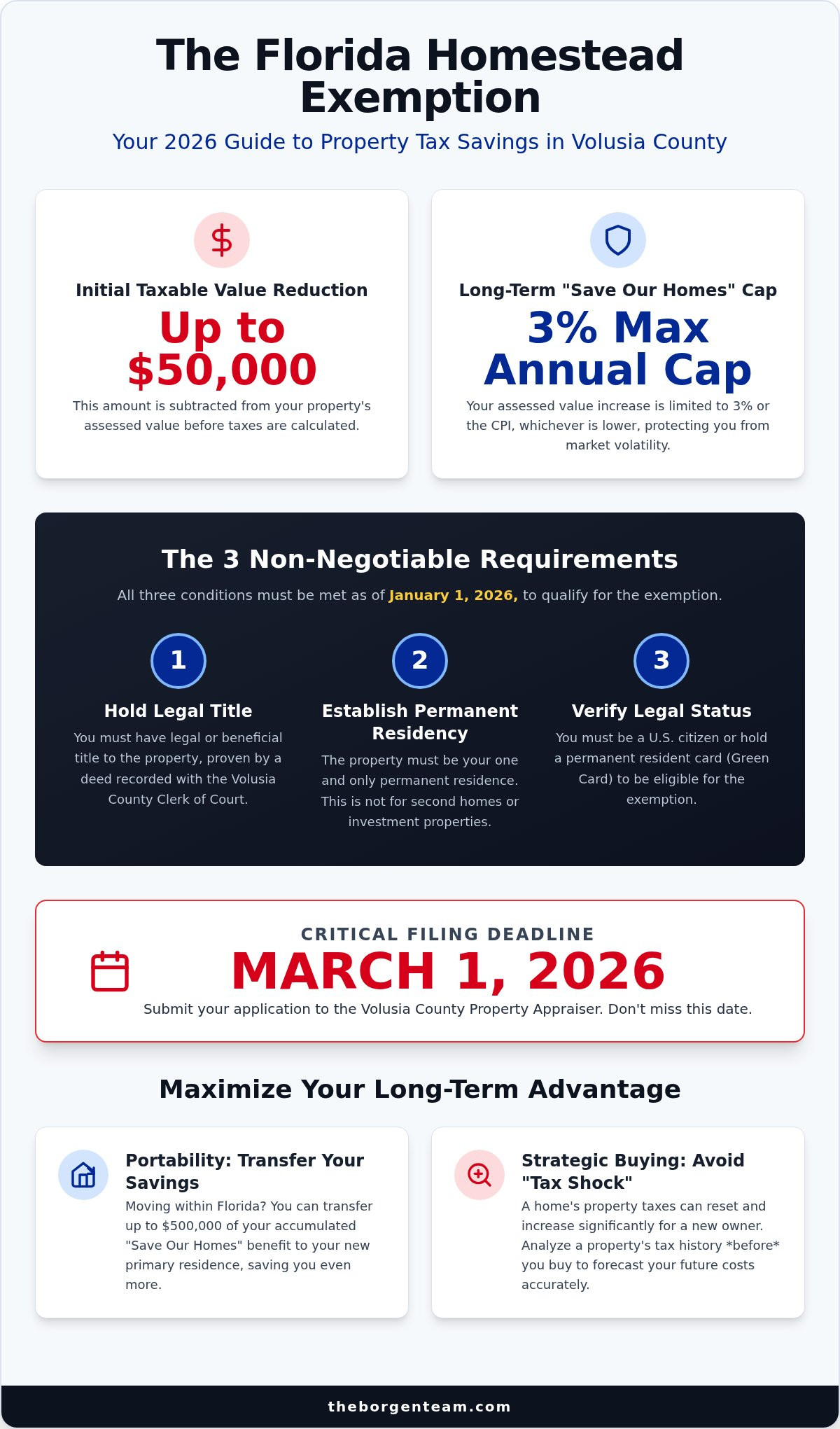
Success in Florida real estate hinges on precision. If you want to secure your tax savings, you must act before the hard deadline of March 1st, 2026. This isn't a flexible window. Failure to submit by this date means waiting another full year to see a reduction in your tax bill. We ensure our clients are prepared long before the tax office opens its portal. Meeting the Florida homestead exemption requirements is a straightforward process if you have your documentation organized and ready for submission.
Don't wait until February to hunt for paperwork. Gather these essential items now to ensure a seamless application. The Volusia County Property Appraiser requires specific proof that you've fully committed to Florida residency. Prepare these documents for every owner who resides on the property:
The Volusia County Property Appraiser offers a streamlined E-File system that makes submission efficient. Navigate to their official portal and follow the step-by-step prompts to upload your digital documents. After you hit submit, the system provides a confirmation number. Save this. It's your official proof of filing. You can track your application status online to ensure the county received and processed your request without issues.
If the appraiser denies your application or requests more evidence, don't panic. You typically have a window to provide additional residency proof. However, if you miss the March 1st deadline entirely, you must prove extenuating circumstances to file a late application. This is a high bar to clear. It's much easier to be proactive. If you're still looking for the perfect home to claim as your own, use our AI-powered property search to find listings in Daytona Beach or Port Orange that are ready for your 2026 homestead. Staying ahead of the Florida homestead exemption requirements is the only way to guarantee your savings.
Purchasing a home in the Florida market is a high-stakes financial move that requires precise calculation. It's not enough to find a property that fits your aesthetic preferences. You must understand how that investment interacts with the local tax landscape. Property taxes are a massive component of your monthly PITI payment, which includes Principal, Interest, Taxes, and Insurance. If you fail to account for the eventual adjustment in assessed value, your monthly budget could be compromised. We position ourselves as your proactive advocate, ensuring you master the Florida homestead exemption requirements before you ever sign a contract.
Many buyers fall into the trap of looking at the seller's current tax bill and assuming they'll pay the same amount. This is a dangerous oversight. If the current owner has lived in the home for years, their taxes are likely suppressed by a long-standing assessment cap. When the title transfers to you, that cap disappears. The Volusia County Property Appraiser will reassess the home based on the current market value, often leading to a significant "tax shock" in your first full year of ownership. This jump can add hundreds of dollars to your monthly mortgage obligation without warning.
To avoid this, you must estimate your future taxes using the specific millage rates for cities like Daytona Beach, Port Orange, or Ormond Beach. We provide the expert guidance needed to perform these calculations during the due diligence period. Relying on a team that understands the nuances of the Florida homestead exemption requirements allows you to buy with total financial clarity. We don't just help you find a house. We help you secure a sustainable financial future in a fast-moving market.
The Borgen Team utilizes cutting-edge, AI-powered search tools to give our clients a distinct competitive edge. Our technology filters through thousands of listings to identify properties in premier Volusia County neighborhoods that align with your long-term goals. Whether you're looking for a luxury estate in New Smyrna Beach or a family home in DeLand, our AI tools provide data-driven insights that go far beyond a standard search bar. This modern methodology allows us to spot homes with optimal tax histories and growth potential before they hit the broader market.
Local expertise remains the cornerstone of our service. Walter Borgen and his team bring decades of experience to the table, providing a signature level of sophistication to every transaction. We blend high-tech resources with deep-rooted knowledge of the Volusia County landscape to ensure you achieve a superior outcome. Don't leave your property tax savings to chance. Search Volusia County listings with The Borgen Team today and take the first step toward a smarter, more secure Florida lifestyle.
Mastering the Florida homestead exemption requirements is more than just a filing task; it's a strategic move to lock in your financial stability. By securing your residency status before the March 1st deadline and leveraging portability, you protect your home from market volatility. You've seen how the assessment cap and the 2026 exemption amounts can save you thousands. Now, it's time to apply this knowledge to your next property acquisition.
Broker Walter Borgen has been a licensed pro since the 1990s, navigating the complexities of the Daytona Beach, Port Orange, and Ormond Beach markets with precision. Our AI-powered property search ensures you find listings with optimal tax profiles from the start. We act as your proactive advocate, translating legal requirements into a clear path for wealth preservation. Don't leave your tax savings to chance when elite expertise is within reach.
Secure your Florida future—contact The Borgen Team for expert Volusia County real estate guidance.
Your dream home in the Sunshine State deserves the protection of Florida’s strongest tax benefits. We look forward to helping you claim them.
The hard deadline to file your application for the 2026 tax year is March 1st, 2026. You must have established your permanent residency and held legal title to your home by January 1st to qualify for that cycle. Missing this date forces you to wait an entire year for savings. Proactive homeowners in Daytona Beach and Port Orange should submit their documentation through the Volusia County Property Appraiser’s portal as early as January to avoid processing delays.
Yes, you can claim the exemption if your property is held in a trust, provided you maintain beneficial title with the right to occupy the home. The trust must grant you a life estate or a specific possessory interest under Florida law. This is a common strategy for luxury property owners in Ponce Inlet and New Smyrna Beach. We recommend reviewing your trust documents with a legal professional to ensure they meet the specific Florida homestead exemption requirements.
Renting out your entire primary residence is typically viewed as an abandonment of your homestead status by the state. While Florida allows for limited rental activity, such as renting a room while you still reside there, leasing the full property for more than 30 days per calendar year for two consecutive years can trigger a loss of the exemption. If you plan to convert your Daytona Beach home into a rental, consult with our team to understand the tax implications.
No, the homestead exemption renews automatically every year as long as your residency and ownership status remain unchanged. You will receive a renewal notice from the Volusia County Property Appraiser each January to confirm your continued eligibility. You only need to notify the appraiser if you sell the property, move your primary residence, or if your legal status changes. This system ensures long-term stability for residents in Ormond Beach and DeLand without annual paperwork.
The exemption reduces your home's taxable value by up to $51,411 for the 2026 tax year. This total includes a base $25,000 exemption for all taxes and an additional inflation-adjusted amount for non-school levies. While the exact dollar savings depend on your local millage rates in cities like Holly Hill or Orange City, most homeowners see a reduction of several hundred dollars annually. The real power lies in the 3% assessment cap that builds significant value over time.
No, you cannot transfer a homestead exemption or similar tax credit from another state to Florida. These benefits are state-specific and don't cross borders. However, once you establish your first Florida homestead, you can use the portability feature to transfer your accumulated Save Our Homes savings to a new property within the state. If you are moving from out of state, your first step is meeting the initial Florida homestead exemption requirements for your new Volusia County residence.
The homestead exemption is a flat deduction from your property's assessed value, while the Save Our Homes cap is a limit on how much that value can increase annually. The exemption provides immediate relief, but the cap offers long-term protection by ensuring your assessed value never rises more than 3% per year. Both benefits work together to stabilize your tax bill. This combination is essential for homeowners in fast-growing markets where market values can fluctuate rapidly.
Yes, Volusia County offers several additional exemptions for specific groups. Seniors aged 65 and older may qualify for an extra exemption if their total household income falls below the 2026 limit of $38,686. Disabled veterans and surviving spouses are also eligible for significant tax relief, sometimes resulting in a total property tax exemption. We encourage residents in South Daytona and Edgewater to check with the Property Appraiser’s office to see if they qualify for these high-value supplemental benefits.

Walter Borgen has lived in the Daytona Beach area for most of his life. Walter started his real estate career in his early 20s as a part time wholesale real estate investor. Quickly Walter became fa....
Did you know that 27% of Volusia County listings currently feature price cuts, yet many buyers still overpay because they lack a data-driven strategy? Entering the 2026 market in Daytona Beach or
Are you unknowingly overpaying your property taxes while your neighbors enjoy massive savings? In the fast-moving Florida real estate market, missing a single detail in your filing can cost you
Will your dream home turn into a tax nightmare after your first year of ownership? Most buyers rely on outdated listing data, only to face a massive escrow shortfall when the county reassesses their
Ask a couple people how the housing market is doing and you’ll probably get a couple different answers. That’s because right now, the market runs on 2 very different tracks, split by
 Copyright © MFRMLS.com All information deemed reliable but not guaranteed. All properties are subject to prior sale, change or withdrawal. Neither listing broker(s) or information provider(s) shall be responsible for any typographical errors, misinformation, misprints and shall be held totally harmless. Listing(s) information is provided for consumers personal, non-commercial use and may not be used for any purpose other than to identify prospective properties consumers may be interested in purchasing. Information on this site was last updated Last updated on September 16, 2026 1:23 PM UTC The listing information on this page last changed on Last updated on September 16, 2026 1:23 PM UTCd. The data relating to real estate for sale on this website comes in part from the Internet Data Exchange program of MFR MLS.
All information deemed reliable but not guaranteed. All properties are subject to prior sale, change or withdrawal. Neither listing broker(s) or information provider(s) shall be responsible for any typographical errors, misinformation, misprints and shall be held totally harmless. Listing(s) information is provided for consumers personal, non-commercial use and may not be used for any purpose other than to identify prospective properties consumers may be interested in purchasing.
Updated on September 16, 2026 1:23 PM UTC
Copyright © MFRMLS.com All information deemed reliable but not guaranteed. All properties are subject to prior sale, change or withdrawal. Neither listing broker(s) or information provider(s) shall be responsible for any typographical errors, misinformation, misprints and shall be held totally harmless. Listing(s) information is provided for consumers personal, non-commercial use and may not be used for any purpose other than to identify prospective properties consumers may be interested in purchasing. Information on this site was last updated Last updated on September 16, 2026 1:23 PM UTC The listing information on this page last changed on Last updated on September 16, 2026 1:23 PM UTCd. The data relating to real estate for sale on this website comes in part from the Internet Data Exchange program of MFR MLS.
All information deemed reliable but not guaranteed. All properties are subject to prior sale, change or withdrawal. Neither listing broker(s) or information provider(s) shall be responsible for any typographical errors, misinformation, misprints and shall be held totally harmless. Listing(s) information is provided for consumers personal, non-commercial use and may not be used for any purpose other than to identify prospective properties consumers may be interested in purchasing.
Updated on September 16, 2026 1:23 PM UTC
33. Required DMCA Notice
The Digital Millennium Copyright Act of 1998, 17 U.S.C. §512, the DMCA, provides recourse for copyright owners who believe that material appearing on the Internet infringes their rights under U.S. copyright law. If you believe in good faith that any content or material made available in connection with our website or services infringes your copyright, you (or your agent) may send us a notice requesting that the content or material be removed, or access to it blocked. Notices must be sent in writing by email to DMCAnotice@MLSGrid.com. The DMCA requires that your notice of alleged copyright infringement include the following information: (1) description of the copyrighted work that is the subject of claimed infringement; (2) description of the alleged infringing content and information sufficient to permit us to locate the content; (3) contact information for you, including your address, telephone number and email address; (4) a statement by you that you have a good faith belief that the content in the manner complained of is not authorized by the copyright owner, or its agent, or by the operation of any law; (5) a statement by you, signed under penalty of perjury, that the information in the notification is accurate and that you have the authority to enforce the copyrights that are claimed to be infringed; and (6) a physical or electronic signature of the copyright owner or a person authorized to act on the copyright owners behalf. Failure to include all of the above information may result in the delay of the processing of your complaint.
 Information is deemed to be reliable, but is not guaranteed. © 2026 MLS. Last Updated September 16, 2026 12:58 PM UTC The information on this sheet has been made available by the MLS and may not be the listing of the provider. Listing data provided by the Daytona Beach Area Association of REALTORS® Internet Data Exchange (IDX) program. Data is believed to be accurate but not warranted.
 New Smyrna Beach Board of REALTORS® All information deemed reliable but not guaranteed. All properties are subject to prior sale, change or withdrawal. Neither listing broker(s) or information provider(s) shall be responsible for any typographical errors, misinformation, misprints and shall be held totally harmless. Listing(s) information is provided for consumer's personal, non-commercial use and may not be used for any purpose other than to identify prospective properties consumers may be interested
in purchasing. The data relating to real estate for sale on this website comes in part from the Internet Data Exchange program of the Multiple Listing Service. Real estate listings held by brokerage firms other than The Signature Sales Team may be marked with the Internet Data Exchange logo and detailed information about those properties will include the name of the listing broker(s) when required by the MLS. Copyright ©2026 All rights reserved.
Last Updated: September 16, 2026 1:40 PM UTC
Show More...
New Smyrna Beach Board of REALTORS® All information deemed reliable but not guaranteed. All properties are subject to prior sale, change or withdrawal. Neither listing broker(s) or information provider(s) shall be responsible for any typographical errors, misinformation, misprints and shall be held totally harmless. Listing(s) information is provided for consumer's personal, non-commercial use and may not be used for any purpose other than to identify prospective properties consumers may be interested
in purchasing. The data relating to real estate for sale on this website comes in part from the Internet Data Exchange program of the Multiple Listing Service. Real estate listings held by brokerage firms other than The Signature Sales Team may be marked with the Internet Data Exchange logo and detailed information about those properties will include the name of the listing broker(s) when required by the MLS. Copyright ©2026 All rights reserved.
Last Updated: September 16, 2026 1:40 PM UTC
Show More...
