
Want to buy a house this year, but not sure if the timing’s right? Seasonally, it may actually be a better time to buy than you expect.Yes, mortgage rates have been ticking up lately –
Dated: September 16 2026
Views: 13
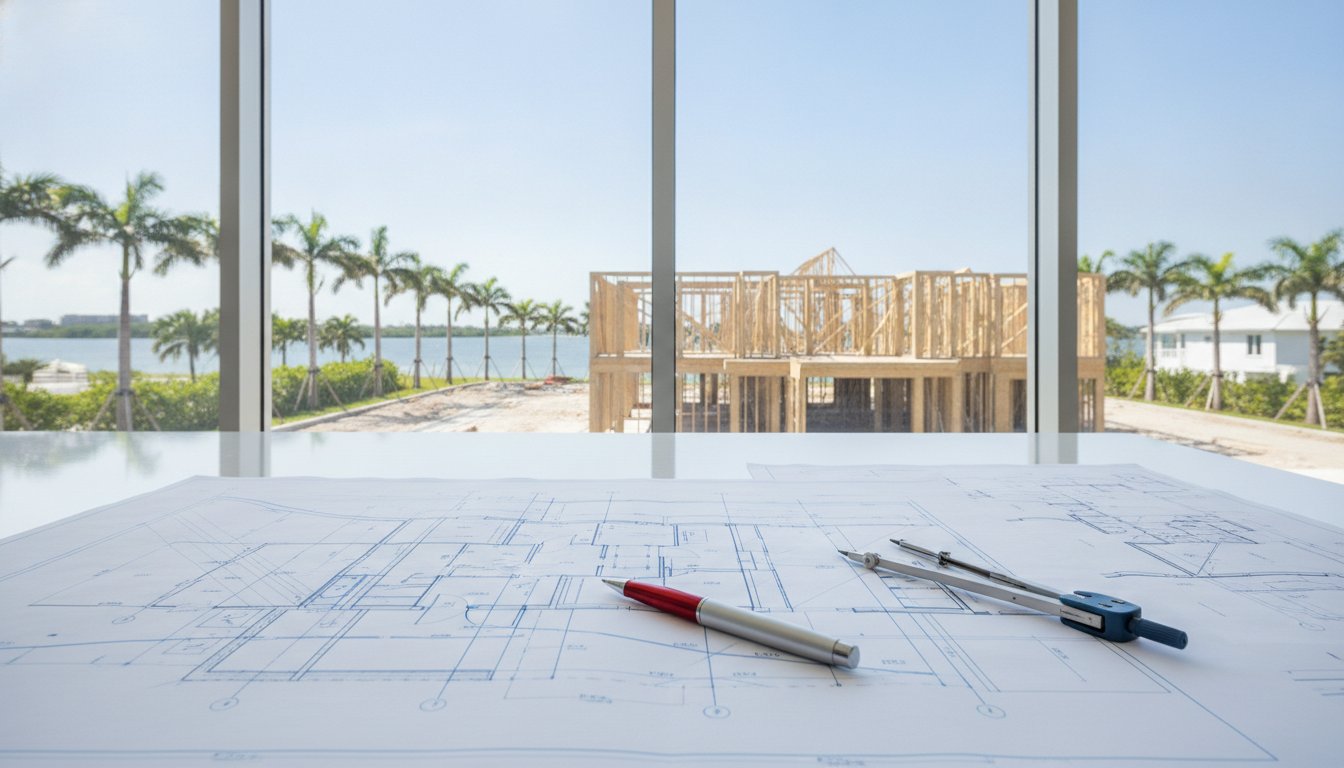
In 2026, your ROI in Central Florida isn't determined by the quality of your granite countertops, but by the exact date you pull your building permit. With the 9th Edition Florida Building Code taking effect on December 31, the window for cost-efficient construction is narrowing. You've likely felt the pressure of volatile material pricing and the frustration of navigating impact fees that vary wildly between DeLand and Daytona Beach. Calculating the true cost to build a house in Volusia County requires more than a simple estimate; it demands a strategic breakdown of a market where impact fees alone can exceed $22,000 per site.
We'll provide the professional framework you need to master this landscape with confidence. You'll gain a clear understanding of the current $150 to $300 per square foot price range and how to leverage the 20-30% affordability advantage found in West Volusia. This guide previews the essential data on land acquisition in high-demand areas like Ponce Inlet and helps you decide if a custom build or a move-in-ready property aligns with your 2026 objectives. Get ready to move from confusion to a decisive, results-oriented construction plan.
The 2026 market in Daytona Beach and DeLand is defined by a strategic shift toward high-efficiency, resilient housing. While the total number of permits saw a 17% decrease in the previous year, the influx of over 4,000 new households into Volusia County, Florida maintains strong upward pressure on demand. This momentum is particularly visible in West Volusia, where affordability and land availability create a competitive alternative to the saturated coastal corridors. For any serious investor or future homeowner, understanding the cost to build a house in Volusia County starts with a clear distinction between hard and soft costs.
Hard costs represent the tangible elements of your project, such as the concrete slab, lumber, and roofing materials. Soft costs are the administrative and strategic expenses, including architectural fees, land surveys, and the county's complex impact fee schedule. In 2026, soft costs have become a larger percentage of the total budget due to annual CPI adjustments and new school impact studies. Precision in these early calculations is what separates a successful move-in from a stalled project.
Custom homes in this region currently range from $150 to $300 per square foot for construction alone. The 2026 standard has shifted toward "smart-ready" homes that integrate AI-managed energy systems and advanced climate control as baseline features rather than luxury add-ons. You'll find a sharp divide between production builders, who prioritize speed and standardized floor plans, and the custom luxury market that focuses on bespoke, hurricane-hardened estates. Choosing the right path depends on your tolerance for a 12 to 18 month build timeline versus the desire for a signature architectural statement.
Labor availability remains a critical variable in the East Central Florida corridor. While supply chains have stabilized since the volatility of the early 2020s, 2026 inflation adjustments continue to influence the cost to build a house in Volusia County. The influence of the "Signature" luxury market is also raising the standard for mid-range builds, as buyers now expect high-end finishes like quartz and impact-rated glass as the new norm. Additionally, interest rates for construction-to-permanent loans have stabilized, but lenders now require more rigorous budget documentation. Secure your financing early to lock in rates before the October 1st permit fee adjustments take effect.
Precision budgeting in 2026 requires a departure from generic estimates. The cost to build a house in Volusia County currently fluctuates between $150 and $300 per square foot, depending heavily on your chosen finish tier and structural complexity. While material costs for lumber and concrete have stabilized compared to the volatility of previous years, labor remains a premium commodity. In the Daytona Beach-Ormond Beach metro area, the demand for specialized trades continues to drive site-specific costs upward, particularly for projects requiring hurricane-hardened specifications.
Many investors assume that increasing square footage automatically lowers the price per foot. This is a common misconception in the 2026 market. While some "bulk" savings exist in foundation and roofing, larger footprints often trigger more complex HVAC requirements and advanced structural engineering. If your budget is sensitive to these fluctuations, you might find that leveraging AI-powered property searches for existing homes provides a more predictable financial outcome.
Your entry point into the market is defined by three distinct tiers. Economy builds, often found in West Volusia production subdivisions, range from $155 to $200 per square foot. At this level, you sacrifice architectural customization and high-end cabinetry for a faster move-in date. Mid-range custom homes typically sit between $200 and $250 per square foot, offering upgraded finishes and smarter floor plans. Luxury estates exceed $250 per square foot, often reaching $300 or more. These projects situated near the shoreline must account for Florida's Coastal Construction Control Line (CCCL) requirements, which mandate specialized engineering and materials to mitigate storm risks.
The "shell" of the home is only half the story. In 2026, kitchen and bath allocations consume approximately 12% to 15% of the total construction budget. High-end descriptors like quartz waterfall islands and custom-integrated appliances are now standard in the luxury segment. Beyond the interior, outdoor living spaces have become essential for maintaining property value. Summer kitchens and salt-water pools can add an additional $60,000 to $120,000 to your bottom line. Furthermore, the modern Volusia home now includes AI-managed energy systems. These smart integrations ensure long-term efficiency but require a higher upfront investment in electrical infrastructure and automated hardware.
Vertical construction is only one part of your financial equation. The cost to build a house in Volusia County is dictated heavily by the "horizontal" variables: the specific plot of land you choose and the regulatory toll required to break ground. In 2026, these soft costs are more than just line items; they're strategic hurdles. Total government fees for a 2,000 square foot home in an unincorporated area typically start around $17,909, but this figure can climb to $24,787 in softened east service areas with county water and sewer. Understanding these local nuances is the difference between a project that stays on track and one that faces immediate budget depletion.
Utility connections represent another critical fork in the road. Opting for a lot with city water and sewer provides convenience but comes with higher upfront impact fees. Conversely, building in more rural areas may require well and septic systems. While this can lower initial government fees to approximately $16,974, you must account for the long-term maintenance and the initial cost of drain field engineering. Every municipality, from DeLand to Ormond Beach, operates on its own permit fee schedule, with many adjusting their rates annually on October 1st based on the Consumer Price Index.
Finding buildable land in high-demand areas like Ponce Inlet requires a modern approach to acquisition. The Borgen Team utilizes AI-powered property searches to identify underbuilt parcels and vacant lots before they reach traditional listing platforms. This technology is vital because not all "vacant" land is ready for a foundation. You must account for lot clearing, debris removal, and soil stabilization, which are significant hidden costs in Florida's sandy or swampy terrain. Zoning restrictions also vary wildly; what's permitted in Deltona may be strictly prohibited in the coastal zones of Ponce Inlet. Always verify setbacks and environmental protections before closing on a parcel.
Impact fees are designed to fund the infrastructure your new home will utilize. In 2026, these fees are a non-negotiable reality of the building process. For a new single-family home in Daytona Beach, total impact fees including county-level charges reach $22,361.67. In unincorporated areas, the baseline is roughly $19,781.04. Here is a breakdown of the core components you'll encounter:
Keep in mind that Florida House Bill 803 has introduced some permit exemptions for residential work under $7,500, but this rarely applies to new construction. Your budget must remain focused on the primary impact fees that hit your bottom line the moment you file for a permit.
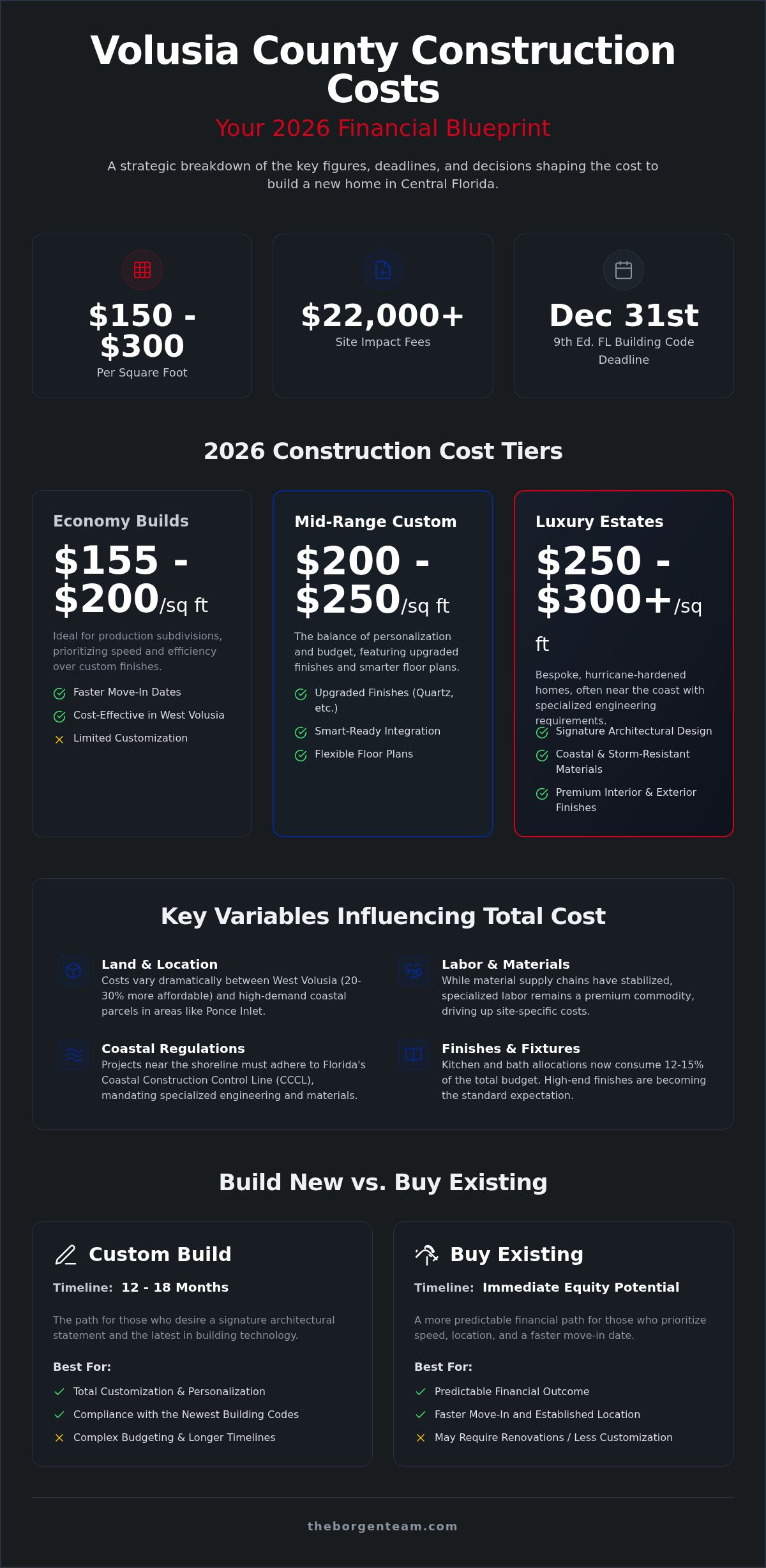
Building on the coast isn't just about the view; it's about engineering against the elements. The cost to build a house in Volusia County increases significantly as you move east of I-95. The 9th Edition Florida Building Code, effective December 31, 2026, introduces even more rigorous wind load requirements and updated wind-load maps. Permits pulled after this date must adhere to these stricter standards, which directly influence your structural budget. You aren't just paying for materials; you're paying for a fortress that meets modern resilience standards.
Insurance is another factor that demands early attention. Builder's risk insurance protects your investment during the 12 to 18 month construction phase, but post-construction premiums are where the real impact lies. Your proximity to the shoreline and your adherence to FEMA elevation requirements will dictate your annual flood and wind insurance rates. Failing to account for these ongoing costs can turn a dream build into a financial burden.
Hurricane-rated glass is no longer an optional upgrade; it's a fundamental budget item for any coastal project. These impact windows and doors are designed to withstand the high-velocity hurricane zones found in Florida. Beyond the glass, your roof strapping and wall-to-foundation connections must meet enhanced 2026 specifications. Foundation choice is also critical. While a monolithic slab might work for inland lots, sandy coastal soils often require a stem wall foundation. This choice provides better stability and helps meet elevation mandates, though it adds to your initial concrete and labor expenses.
Site preparation in areas like Ormond-by-the-Sea or New Smyrna Beach involves more than just clearing brush. You must account for Florida's Coastal Construction Control Line (CCCL) regulations, which mandate specialized design criteria to mitigate erosion. FEMA elevation requirements also dictate how high your first finished floor must sit. If your lot falls within a high-risk flood zone, expect foundation costs to jump as you engineer for hydrostatic pressure and potential surge.
Environmental factors often catch builders off guard. Volusia County is home to protected species, such as the Gopher Tortoise. Finding a burrow on your land requires a formal environmental survey and potential relocation fees, which can cost thousands of dollars per tortoise. Soil testing and compaction are also mandatory in sandy areas to ensure the ground can support the weight of a modern custom home. If these technical hurdles seem daunting, consider consulting with our land acquisition experts to find a lot that minimizes these hidden risks and maximizes your long-term ROI.
The final decision to break ground or sign a closing statement hinges on a clear-eyed financial delta. As of August 2026, the median sale price in Volusia County remains approximately $343,000. Contrast this with the average permitted home value of $380,567, and it's clear that new construction carries a premium. When you calculate the total cost to build a house in Volusia County, you aren't just paying for modern aesthetics; you're investing in the 9th Edition Florida Building Code standards and the latest in AI-managed efficiency. However, you must weigh this against the 12 to 18 month build timeline. This "opportunity cost" includes not just your current carrying costs, but also the potential equity growth you miss by not being in the market today.
Many luxury buyers in Daytona Beach and New Smyrna Beach are pivoting toward a middle ground: renovated estates. By targeting homes built between 2022 and 2025, you can secure "near-new" inventory that already meets recent hurricane standards without the regulatory wait times. We utilize AI-powered property searches to identify these under-market gems that offer the same structural integrity as a 2026 build but are ready for immediate occupancy. This strategy often yields a higher immediate ROI by bypassing the peak pricing of current labor and material cycles.
While the upfront cost to build a house in Volusia County is higher, the long-term appreciation of new construction typically outpaces older inventory. You'll benefit from a "maintenance holiday" for the first decade, with significant savings on insurance premiums due to modern roof-to-wall connections and impact-rated glass. Building makes the most sense when your specific lifestyle needs-such as a multi-generational suite or a specialized home office-simply don't exist in the current market. If you can't find your vision in the existing $327,100 typical home value range, building becomes the logical path to a signature residence.
Navigating the "Build vs. Buy" debate requires a strategic partner who understands both the dirt and the finished product. The Borgen Team of REMAX Signature provides the high-tier expertise needed to evaluate construction contracts or locate prime land parcels. We don't just show properties; we act as proactive advocates who utilize cutting-edge tools to stay ahead of market shifts. Whether you're looking for vacant land in DeLand or a waterfront estate in Ponce Inlet, our team delivers the data-driven clarity you need to move forward. Reach out today to request a custom market analysis that compares your projected building costs with the most competitive local listings currently available.
Success in the 2026 real estate landscape requires a decisive strategy. You've seen how the true cost to build a house in Volusia County involves balancing a $150 to $300 per square foot construction range with site-specific impact fees and the upcoming 9th Edition Florida Building Code. Whether you choose to break ground in DeLand or secure a hurricane-hardened estate in New Smyrna Beach, your ROI depends on precise data and proactive timing. The window for cost-efficient construction is closing; now is the time to act.
Don't leave your investment to chance. Leverage the global network authority of The Borgen Team of REMAX Signature and our advanced AI-powered property search tools to find the perfect parcel or move-in-ready home. With decades of local Volusia County expertise, we act as your strategic partner in this fast-moving landscape. Your vision for a signature Florida home is within reach when you collaborate with experts who prioritize your results. Explore Volusia County Land and Homes with The Borgen Team today to take command of your next project. We're ready to help you turn these market insights into a reality.
The average cost per square foot ranges from $150 to $300 as of September 2026. Production homes in West Volusia subdivisions generally fall between $155 and $200 per square foot for construction alone. Coastal projects in areas like New Smyrna Beach command the higher end of the spectrum due to stricter building codes and luxury finish demands. These figures exclude land acquisition and specific impact fees which vary by municipality.
Impact fees for a new single-family home in unincorporated areas total approximately $19,781.04. If you're building within Daytona Beach city limits, expect to pay roughly $22,361.67 as of July 2026. A significant portion of this is the Volusia County Schools Impact Fee, which is currently set at $7,022.70. These fees fund essential infrastructure like roads, parks, and fire services required for your new residence.
Permitting timelines in Daytona Beach typically range from 30 to 60 days for initial residential reviews. However, projects located east of the Coastal Construction Control Line often face longer wait times due to additional environmental and structural engineering approvals. You should factor this into your total 12 to 18 month construction schedule. Securing a complete application with all required soil tests and surveys is the most efficient way to prevent administrative delays.
Buying an existing home is currently the more cost-effective option for most residents. The median sale price is approximately $343,000; however, the average permitted value for new construction exceeds $380,000. When you factor in the total cost to build a house in Volusia County, existing inventory often provides better immediate equity. Use AI-powered property searches to find "near-new" homes that offer modern standards without the build-time premium.
The 9th Edition Florida Building Code, effective December 31, 2026, mandates enhanced resilience against high-velocity winds. New homes must feature impact-rated windows and doors or approved shutter systems to protect the building envelope. Requirements also include rigorous roof-to-wall connections and updated wind-load maps. These standards ensure your property can withstand major storm events, which is particularly critical for waterfront estates in Ponce Inlet and Ormond-by-the-Sea.
Yes, many high-end communities and historic districts in Volusia County utilize Architectural Review Boards (ARBs). If you're building in a master-planned community or a historic area in DeLand, your design must meet specific aesthetic and material standards. These boards ensure that new custom homes maintain the neighborhood's visual integrity and property values. Always verify the Covenants, Conditions, and Restrictions of your chosen lot before finalizing your architectural plans.
You can build modular homes in Volusia County, provided they meet the same Florida Building Code standards as site-built residences. Modular construction can offer significant savings on labor and time, though zoning restrictions in certain municipalities may limit their placement. DeLand has recently explored affordable housing initiatives like tiny-home communities, showing a growing openness to alternative construction methods. Always consult with local zoning departments to ensure your specific modular model is permitted.
Land acquisition is the first and most critical step in the building process. You must secure a buildable lot that aligns with your budget and structural goals before commissioning architectural plans. The Borgen Team specializes in finding these opportunities, using AI-powered tools to identify parcels in DeLand or Ormond Beach that aren't on the traditional market. Once you secure the land, you can proceed with soil testing and environmental surveys with confidence.

Walter Borgen has lived in the Daytona Beach area for most of his life. Walter started his real estate career in his early 20s as a part time wholesale real estate investor. Quickly Walter became fa....
Want to buy a house this year, but not sure if the timing’s right? Seasonally, it may actually be a better time to buy than you expect.Yes, mortgage rates have been ticking up lately –
In 2026, your ROI in Central Florida isn't determined by the quality of your granite countertops, but by the exact date you pull your building permit. With the 9th Edition Florida Building Code
What if the most prestigious oceanfront address in Florida is actually a financial liability in disguise? As we move through 2026, the local market is no longer just about floor-to-ceiling glass and
What if you could analyze every listing in Daytona Beach and New Smyrna Beach in the time it takes to pour a cup of coffee? In a market where 901 homes sold in July 2026 alone, relying on manual
 Copyright © MFRMLS.com All information deemed reliable but not guaranteed. All properties are subject to prior sale, change or withdrawal. Neither listing broker(s) or information provider(s) shall be responsible for any typographical errors, misinformation, misprints and shall be held totally harmless. Listing(s) information is provided for consumers personal, non-commercial use and may not be used for any purpose other than to identify prospective properties consumers may be interested in purchasing. Information on this site was last updated Last updated on September 19, 2026 3:40 PM UTC The listing information on this page last changed on Last updated on September 19, 2026 3:40 PM UTCd. The data relating to real estate for sale on this website comes in part from the Internet Data Exchange program of MFR MLS.
All information deemed reliable but not guaranteed. All properties are subject to prior sale, change or withdrawal. Neither listing broker(s) or information provider(s) shall be responsible for any typographical errors, misinformation, misprints and shall be held totally harmless. Listing(s) information is provided for consumers personal, non-commercial use and may not be used for any purpose other than to identify prospective properties consumers may be interested in purchasing.
Updated on September 19, 2026 3:40 PM UTC
Copyright © MFRMLS.com All information deemed reliable but not guaranteed. All properties are subject to prior sale, change or withdrawal. Neither listing broker(s) or information provider(s) shall be responsible for any typographical errors, misinformation, misprints and shall be held totally harmless. Listing(s) information is provided for consumers personal, non-commercial use and may not be used for any purpose other than to identify prospective properties consumers may be interested in purchasing. Information on this site was last updated Last updated on September 19, 2026 3:40 PM UTC The listing information on this page last changed on Last updated on September 19, 2026 3:40 PM UTCd. The data relating to real estate for sale on this website comes in part from the Internet Data Exchange program of MFR MLS.
All information deemed reliable but not guaranteed. All properties are subject to prior sale, change or withdrawal. Neither listing broker(s) or information provider(s) shall be responsible for any typographical errors, misinformation, misprints and shall be held totally harmless. Listing(s) information is provided for consumers personal, non-commercial use and may not be used for any purpose other than to identify prospective properties consumers may be interested in purchasing.
Updated on September 19, 2026 3:40 PM UTC
33. Required DMCA Notice
The Digital Millennium Copyright Act of 1998, 17 U.S.C. §512, the DMCA, provides recourse for copyright owners who believe that material appearing on the Internet infringes their rights under U.S. copyright law. If you believe in good faith that any content or material made available in connection with our website or services infringes your copyright, you (or your agent) may send us a notice requesting that the content or material be removed, or access to it blocked. Notices must be sent in writing by email to DMCAnotice@MLSGrid.com. The DMCA requires that your notice of alleged copyright infringement include the following information: (1) description of the copyrighted work that is the subject of claimed infringement; (2) description of the alleged infringing content and information sufficient to permit us to locate the content; (3) contact information for you, including your address, telephone number and email address; (4) a statement by you that you have a good faith belief that the content in the manner complained of is not authorized by the copyright owner, or its agent, or by the operation of any law; (5) a statement by you, signed under penalty of perjury, that the information in the notification is accurate and that you have the authority to enforce the copyrights that are claimed to be infringed; and (6) a physical or electronic signature of the copyright owner or a person authorized to act on the copyright owners behalf. Failure to include all of the above information may result in the delay of the processing of your complaint.
 Information is deemed to be reliable, but is not guaranteed. © 2026 MLS. Last Updated September 19, 2026 3:50 PM UTC The information on this sheet has been made available by the MLS and may not be the listing of the provider. Listing data provided by the Daytona Beach Area Association of REALTORS® Internet Data Exchange (IDX) program. Data is believed to be accurate but not warranted.
 New Smyrna Beach Board of REALTORS® All information deemed reliable but not guaranteed. All properties are subject to prior sale, change or withdrawal. Neither listing broker(s) or information provider(s) shall be responsible for any typographical errors, misinformation, misprints and shall be held totally harmless. Listing(s) information is provided for consumer's personal, non-commercial use and may not be used for any purpose other than to identify prospective properties consumers may be interested
in purchasing. The data relating to real estate for sale on this website comes in part from the Internet Data Exchange program of the Multiple Listing Service. Real estate listings held by brokerage firms other than The Signature Sales Team may be marked with the Internet Data Exchange logo and detailed information about those properties will include the name of the listing broker(s) when required by the MLS. Copyright ©2026 All rights reserved.
Last Updated: September 19, 2026 3:16 PM UTC
Show More...
New Smyrna Beach Board of REALTORS® All information deemed reliable but not guaranteed. All properties are subject to prior sale, change or withdrawal. Neither listing broker(s) or information provider(s) shall be responsible for any typographical errors, misinformation, misprints and shall be held totally harmless. Listing(s) information is provided for consumer's personal, non-commercial use and may not be used for any purpose other than to identify prospective properties consumers may be interested
in purchasing. The data relating to real estate for sale on this website comes in part from the Internet Data Exchange program of the Multiple Listing Service. Real estate listings held by brokerage firms other than The Signature Sales Team may be marked with the Internet Data Exchange logo and detailed information about those properties will include the name of the listing broker(s) when required by the MLS. Copyright ©2026 All rights reserved.
Last Updated: September 19, 2026 3:16 PM UTC
Show More...
